Episodes

March 3, 2026
Why choose a SPAC over a traditional IPO?
Ranjeet Sundher explains why Tactical Resources selected the SPAC path to go public in the U.S. With MP Materials serving as a successful template for rare earth production via DESPAC, Tactical aims to become the second producing rare earth company in the U.S. He also shares why partnering with the Plum team made strategic sense after nearly a year of collaboration on structure and financing. Disclaimer: Michael J. Blankenship is a licensed attorney and partner at Winston Taylor. Joshua Wilson ...

March 2, 2026
Why Vertical Integration in West Texas Is a Strategic Advantage
Ranjeet Sundher explains how vertical integration in West Texas reduces operational risk and strengthens domestic production. From direct leach processing onsite to producing mixed hydroxides in Texas, this strategy aims to keep critical mineral value creation inside the United States. Disclaimer: Michael J. Blankenship is a licensed attorney and partner at Winston Taylor. Joshua Wilson is a licensed Florida real estate broker and holds FINRA Series 79 and Series 63 licensure. The content of th...
Guest: Ranjeet Sundher

Feb. 25, 2026
Rare Earths: The Invisible Backbone of Technology and U.S. National Security
Rare earths aren’t abstract commodities. They power daily life and national defense. In this clip, Ranjeet Sundher explains how rare earth magnets sit behind nearly every electronic device from smartphones and laptops to AI chips and advanced defense systems. With China historically supplying over 95% of global rare earth magnets, domestic production carries significant economic and national security implications. Disclaimer: Michael J. Blankenship is a licensed attorney and partner at Winsto...
Guest: Ranjeet Sundher

Feb. 24, 2026
Why does being a direct leach rare earth project matter?
In this clip, Ranjeet Sundher explains why Tactical Resources’ hard rock, direct-leach mineralization is such a rare technical advantage. By bypassing multiple expensive and environmentally intensive processing steps, the project offers a faster, cleaner, and potentially more cost-effective path to producing mixed rare earth products. Mother Nature did the hard work and that changes the economics. Disclaimer: Michael J. Blankenship is a licensed attorney and partner at Winston Taylor. Joshua W...
Guest: Ranjeet Sundher

Feb. 23, 2026
Why Consistent Mineralization Is a Game Changer for Rare Earth Mining
Ranjeet Sundher explains why uniform mineralization at the Peak Project is a major technical advantage. Processing facilities are engineered for specific grades and product types. When mineral grades vary widely across a site, processing becomes more complex, more expensive, and higher risk. Peak’s homogenous mineralization means: • More predictable processing • Lower operating costs • Reduced technical risk • Smoother scale-up to commercial production Disclaimer: Michael J. Blankenship i...
Guest: Ranjeet Sundher

Feb. 20, 2026
Guest Spotlight: Ranjeet Sundher
Ranjeet Sundher, CEO of Tactical Resources, explains what makes the Peak Project fundamentally different from early-stage rare earth developments in the United States. Unlike projects that require a decade of exploration and billions in capital before proving viability, Peak already has materials on site, existing infrastructure, and decades of groundwork completed. The focus now shifts from exploration risk to commercial application and scale. Disclaimer: Michael J. Blankenship is a licensed ...
Guest: Ranjeet Sundher

Feb. 19, 2026
Why Nuclear’s Supply Chain Is the Real Opportunity
Chris Sorrells shares the through-line connecting NuScale and Eagle Energy Metals. From his early exposure to nuclear markets in 1998 to helping build nuclear simulation platforms and supporting NuScale through licensing, Chris explains why first-mover advantage in SMRs mattered and why the next opportunity lies deeper in the supply chain. With SMRs advancing toward commercialization, fuel and uranium supply have become the critical, tech-agnostic bottlenecks. Eagle Energy Metals represents tha...
Guest: Chris Sorrells

Feb. 18, 2026
The Real Bottleneck in the U.S. Rare Earth Supply Chain
Why is feedstock the true bottleneck in the U.S. rare earth supply chain? In this clip, Kanishka Roy breaks down the “mine to magnet” ecosystem and explains why magnet manufacturing is expanding faster than rare earth production. The real constraint isn’t building magnets, it’s developing and scaling rare earth feedstock. Tactical Resources aims to address that bottleneck with an operational mine and surface level tailings ready for processing. Disclaimer: Michael J. Blankenship is a licensed ...

Feb. 17, 2026
Why Tactical Resources Stood Out in the Rare Earths Race
What made Tactical Resources different from other critical mineral opportunities? In this clip, Kanishka Roy explains why near-term execution, existing infrastructure, and 4 million tons of rare-earth-enriched tailings in West Texas made Tactical Resources uniquely positioned. With decades of operational history and a clear playbook similar to MP Materials, this opportunity offered scale, speed to monetization, and long-term runway without the need for multi-billion-dollar infrastructure builds...
Guest: Kanishka Roy

Feb. 16, 2026
How to Tell if a SPAC Deal Price Is Fair
How do analysts determine if a SPAC deal price is fair? Ryan McGuire breaks down the valuation process, from income and market approaches to DCF models, explaining how fairness opinions assess whether shareholders receive appropriate value. Guest: Ryan McGuire: https://www.linkedin.com/in/ryanquinnmaguire/ Let’s Connect on LinkedIn: 👉 Michael J. Blankenship - https://www.linkedin.com/in/mikeblankenship/ 👉 Joshua Bruce Wilson - https://www.linkedin.com/in/joshuabrucewilson/ To Contact Us or Coll...
Guest: Ryan Maguire

Feb. 13, 2026
NASDAQ vs. NYSE for SPACs; What Sponsors Should Consider
Chris Cottone breaks down the key differences between listing a SPAC on NASDAQ versus the NYSE. He explains why most SPAC IPOs historically land on NASDAQ, how exchange preferences can vary depending on sponsor relationships, and why NASDAQ has become more stringent during the DESPAC phase. Disclaimer: Michael J. Blankenship is a licensed attorney and partner at Winston Taylor. Joshua Wilson is a licensed Florida real estate broker and holds FINRA Series 79 and Series 63 licensure. The content...
Guest: Chris Cottone

Feb. 12, 2026
Why Now Is the Moment for Rare Earths And Why Tactical Resources
Kanishka Roy explains why Plum believes now is the right time to back a rare earths company like Tactical Resources. He breaks down the massive global demand across tech-enabled industries, the geopolitical supply constraints tied to China’s dominance, and why scale and near-term operational capability are critical differentiators in this sector. Disclaimer: Michael J. Blankenship is a licensed attorney and partner at Winston Taylor. Joshua Wilson is a licensed Florida real estate broker and h...
Guest: Kanishka Roy

Feb. 10, 2026
Guest Spotlight: Kanishka Roy
Kanishka Roy, Chairman and CEO of Plum Acquisition Corp. IV, joins The SPAC Podcast to share his background as an operator, investment banker, and investor. He walks through the evolution of the Plum platform, now on its fourth SPAC, and explains the team’s focus on differentiated companies with strong execution moats and proven public-market playbooks. Disclaimer: Michael J. Blankenship is a licensed attorney and partner at Winston Taylor. Joshua Wilson is a licensed Florida real estate broker...
Guest: Kanishka Roy

Feb. 9, 2026
How Long Does an IPO Really Take? What to Expect Today
Chris Cottone breaks down realistic IPO timelines based on current market conditions. He explains how IPOs can move as fast as three months in low-comment environments, why four months is now the typical expectation, and what factors can extend the process to six or seven months. Disclaimer: Michael J. Blankenship is a licensed attorney and partner at Winston Taylor. Joshua Wilson is a licensed Florida real estate broker and holds FINRA Series 79 and Series 63 licensure. The content of this po...
Guest: Chris Cottone

Feb. 6, 2026
Why Fairness Opinions Matter in DESPAC Transactions
Ryan McGuire explains why fairness opinions are essential in DESPAC transactions. He outlines how they protect shareholders, align interests between sponsors and investors, and prevent deal structures that could harm equity holders. Hosted by Michael Blankenship, this conversation dives into how fairness opinions shape accountability and trust in SPAC deals. Guest: Ryan McGuire: https://www.linkedin.com/in/ryanquinnmaguire/ Let’s Connect on LinkedIn: Michael J. Blankenship - https://www.linke...
Guest: Ryan Maguire

Feb. 5, 2026
How Are SPAC Deals Different Today?
SPACs have gone through several evolutionary cycles, and today’s transactions look very different from those of just a few years ago. In this episode of The SPAC Podcast, Seth Farbman, Chairman of Vstock Transfer, joins Michael Blankenship and Joshua Wilson to break down the changes shaping SPAC 2.0 (or even 3.0). From deal size and sponsor dynamics to the expanded cast of participants—including auditors, custodians, and transfer agents—Seth shares insights from the front lines of modern SPAC e...
Guest: Seth Farbman

Feb. 3, 2026
SPAC Updates: What Changed, What’s Working, and What to Watch in 2026
Mike Blankenship kicks off a new SPAC Updates series, breaking down how the SPAC market has evolved heading into 2026. He covers SPAC 2.0 structures, sponsor economics, IPO and DESPAC trends, capital costs, PIPE dynamics, redemptions, digital assets, AI, energy, and what sponsors and targets must do to succeed in today’s environment. This episode sets the foundation for ongoing market updates designed to educate founders, investors, and dealmakers navigating the modern SPAC landscape. Disclaim...

Jan. 30, 2026
How to Choose the Right Legal Counsel and Underwriter for a SPAC
Chris Cottone explains how SPAC sponsors should think about selecting legal counsel and underwriters. He outlines why fees should never be the primary decision factor, why SPACs require highly specialized legal experience, and how the wrong choices can lead to delays, added costs, or failed transactions. Disclaimer: Michael J. Blankenship is a licensed attorney and partner at Winston Taylor. Joshua Wilson is a licensed Florida real estate broker and holds FINRA Series 79 and Series 63 licensur...
Guest: Chris Cottone

Jan. 29, 2026
How the SPAC Model Has Matured, What Still Gets Misunderstood
Andrejka Bernatova explains how the SPAC model has evolved since the boom years and why many misconceptions still persist. She shares why SPACs should be viewed as a long-standing capital markets tool, not a short-term trend, and why the structure only works for companies that are truly ready to be public and operating in high-growth, high-interest sectors. Disclaimer: Michael J. Blankenship is a licensed attorney and partner at Winston Taylor. Joshua Wilson is a licensed Florida real estate b...
Guest: Andrejka Bernatova

Jan. 28, 2026
What an Ideal SPAC Board Should Look Like
Chris Cottone explains how SPAC sponsors should think about board composition. From NASDAQ independence requirements to the importance of financial, legal, and M&A experience, he breaks down why a lean, well-balanced board is critical for governance and deal execution. Disclaimer: Michael J. Blankenship is a licensed attorney and partner at Winston Taylor. Joshua Wilson is a licensed Florida real estate broker and holds FINRA Series 79 and Series 63 licensure. The content of this podcast is for...
Guest: Chris Cottone

Jan. 27, 2026
The Next Phase of the SPAC Market: Fewer Deals, Better Sponsors
Chris Sorrells shares his view on where the SPAC market is headed next. After years of excess, he explains why rationalization, more experienced sponsors, cleaner vehicles, and better capital alignment are critical for long-term health. He also outlines why greater discipline and sponsor accountability could strengthen the structure moving forward. Disclaimer: Michael J. Blankenship is a licensed attorney and partner at Winston Taylor. Joshua Wilson is a licensed Florida real estate broker and...
Guest: Chris Sorrells
Jan. 26, 2026
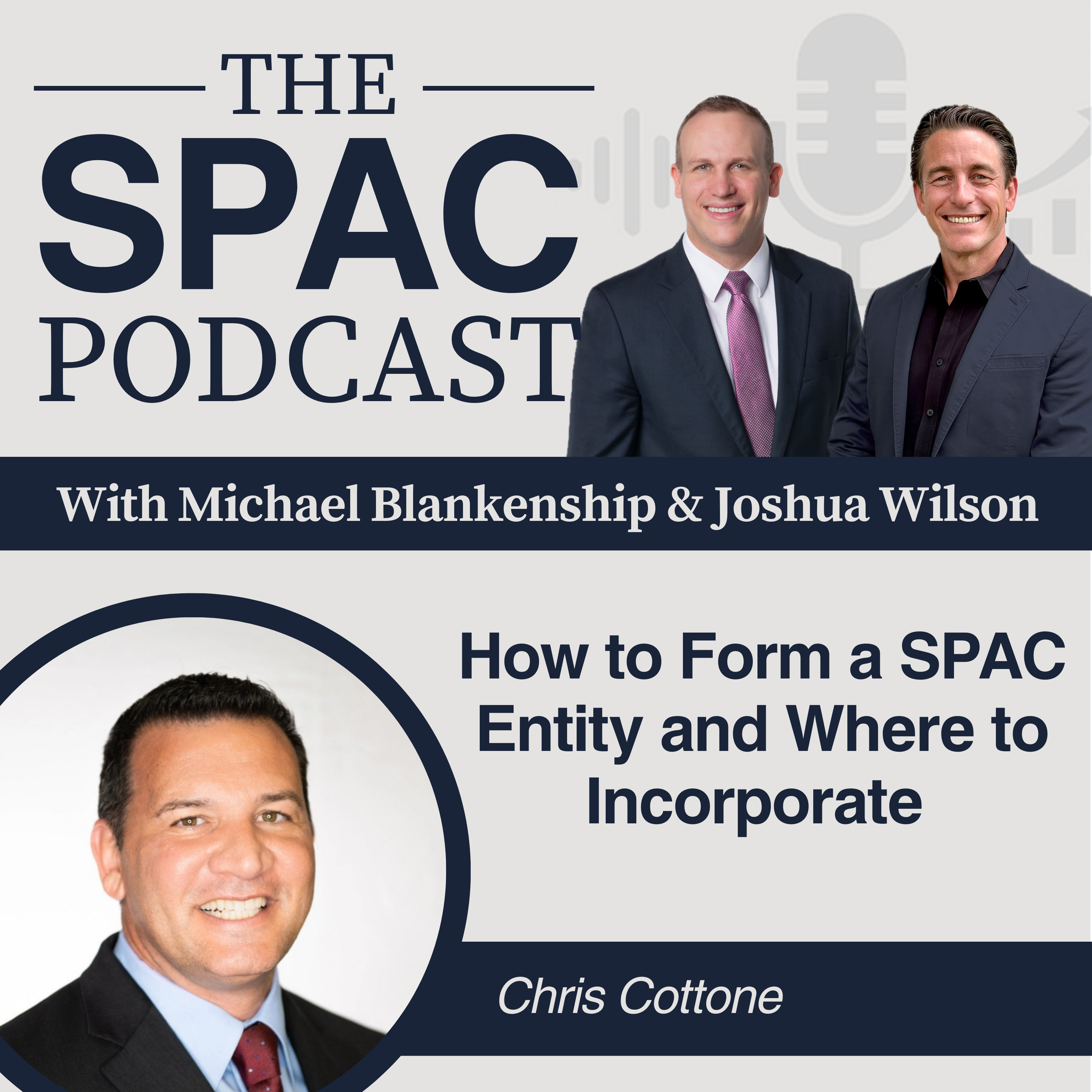
How to Form a SPAC Entity and Where to Incorporate
Chris Cottone explains how to properly form a SPAC entity and why incorporation choice matters. He breaks down the pros and cons of Delaware, Nevada, and Cayman structures, highlighting tax considerations, litigation risk, and cost differences sponsors should understand before launching a SPAC. Disclaimer: Michael J. Blankenship is a licensed attorney and partner at Winston Taylor. Joshua Wilson is a licensed Florida real estate broker and holds FINRA Series 79 and Series 63 licensure. The cont...
Guest: Chris Cottone

Jan. 23, 2026
What the Rise of Continuation Vehicles Means for Public Markets and SPACs
As continuation vehicles and secondaries gain momentum in private equity, Andrejka Bernatova explains what this shift means for investors, sponsors, and LPs. She shares why IPOs and SPACs should still be primary exit paths, how public markets remain open, and why SPACs offer a uniquely discreet way for sponsors to test public-market readiness. Disclaimer: Michael J. Blankenship is a licensed attorney and partner at Winston Taylor. Joshua Wilson is a licensed Florida real estate broker and holds...
Guest: Andrejka Bernatova

Jan. 22, 2026
Why Operator Experience Is the Real Advantage in SPAC Leadership
Andrejka Bernatova explains how being both an operator and a sponsor shapes a fundamentally different approach to SPACs. She shares why the real work starts after the DESPAC, how balance sheet structure and public-company readiness matter, and what separates long-term public companies from short-lived transactions. Disclaimer: Michael J. Blankenship is a licensed attorney and partner at Winston Taylor. Joshua Wilson is a licensed Florida real estate broker and holds FINRA Series 79 and Series ...