

 YouTube

 Apple Podcasts

 Spotify

 iHeartRadio

 Podcast Addict

 Podchaser

 Deezer

 PlayerFM

 Castbox

 Goodpods

 RSS Feed

 Amazon Music
What PIPE Investors Tell You About a SPAC Deal
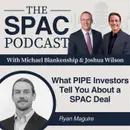
Ryan McGuire explains why PIPE investors act as a real-time market check on a SPAC deal, and what their participation or hesitation reveals about fairness.
Key Takeaways
- Ryan McGuire describes a PIPE as a real-time market check on a SPAC deal.
- If PIPE investors come in on the same terms as other shareholders, he says that is a good sign the deal is fair.
- If a deal needs sweeteners such as discounts or warrants to attract PIPE money, McGuire says that may signal it is less appealing and possibly less fair.
PIPE investors act as a real-time market check on a SPAC deal. Ryan McGuire explains what their participation (or hesitation) reveals about a transaction’s fairness and long-term outlook.
Guest: Ryan McGuire: https://www.linkedin.com/in/ryanquinnmaguire/
Watch more episodes at: www.Youtube.com/@UCiOCVRrRqqmq20QNV9I43Zg
Let’s Connect on LinkedIn:
👉 Michael J. Blankenship - https://www.linkedin.com/in/mikeblankenship/
👉 Joshua Bruce Wilson - https://www.linkedin.com/in/joshuabrucewilson/
To Contact Us or Collaborate:
🎙️ https://www.TheSPACPodcast.com/contact/
Disclaimer: Michael J. Blankenship is a licensed attorney and partner at Winston Taylor. Joshua Wilson is a licensed Florida real estate broker and holds FINRA Series 79 and Series 63 licensure. The content of this podcast is for informational and educational purposes only and should not be considered legal, financial, or compliance advice. All views and opinions expressed by the hosts and guests are their own and do not necessarily reflect the policies or positions of any regulatory agency, law firm, organization, or employer. Listeners should consult their own legal counsel, compliance teams, or financial advisors to ensure adherence to applicable regulations, including SEC, FINRA, and other industry-specific requirements. This podcast does not constitute a solicitation or recommendation for any financial products or services.
Let's Connect on LinkedIn:
https://www.linkedin.com/in/mikeblankenship/ https://www.linkedin.com/in/joshuabrucewilson/
To Contact Us, Please Visit:
https://www.TheSPACPodcast.com/contact/
Frequently Asked Questions
What does a PIPE tell you about a SPAC deal?
Ryan McGuire calls the PIPE a real-time market check. Attracting PIPE investors on the same terms as other shareholders is a good indication the deal is fair.
What is a PIPE in a SPAC?
A PIPE is a private investment in public equity, capital raised alongside a de-SPAC. McGuire says investors' willingness to participate helps signal whether the transaction is fair.
What does it mean if a SPAC has to sweeten a PIPE?
According to McGuire, needing discounts, warrants or other incentives to attract PIPE money may signal the transaction is less appealing to the capital markets and may not be as fair.
Michael Blankenship:
In SPACs, we often see PIPEs, private investment in public equity, come into play. What role does that play in determining fairness, if any?
Ryan McGuire:
The PIPE is really a real-time market check on the deal.
If you’re able to attract PIPE investment at the same terms that other shareholders are getting, that’s a good indication that it’s a fair deal.
If you need to sweeten the deal, offer discounts, warrants, or other incentives, and really have to work hard to attract PIPE money, that might signal that the transaction isn’t as appealing to capital markets and may not be as fair of a deal.

Director of Valuations
Ryan leads Intelek’s North American valuation practice with deep expertise across a range of technical and high-growth segments. Based in Denver, Colorado, he brings nearly a decade of business valuation experience, with a particular focus on pre-IPO and venture-backed companies.
Ryan has delivered hundreds of valuations for clients across technology, life sciences, SaaS, fintech, and consumer sectors. His core areas of expertise include ASC 820 portfolio valuation for investment funds, IRC §409A valuations for startups and scale-ups, and valuations for gift and estate tax purposes across a wide spectrum of ownership structures and industries. Ryan also has extensive experience with ASC 805 purchase price allocations, M&A strategy support, and complex capital structure modeling.
Prior to joining Intelek, Ryan was a Manager at Frank, Rimerman + Co., where he helped shape the firm’s venture valuation offering and led training and technical development initiatives across the team.
Ryan is a Certified Public Accountant (CPA) and holds the Accredited in Business Valuation (ABV) credential.” He holds dual degrees in Accounting and Finance from Wittenberg University.
When he’s not knee-deep in cap tables or waterfall models, you’ll find him enjoying Colorado’s great outdoors or lending his time to nonprofit and philanthropic causes.